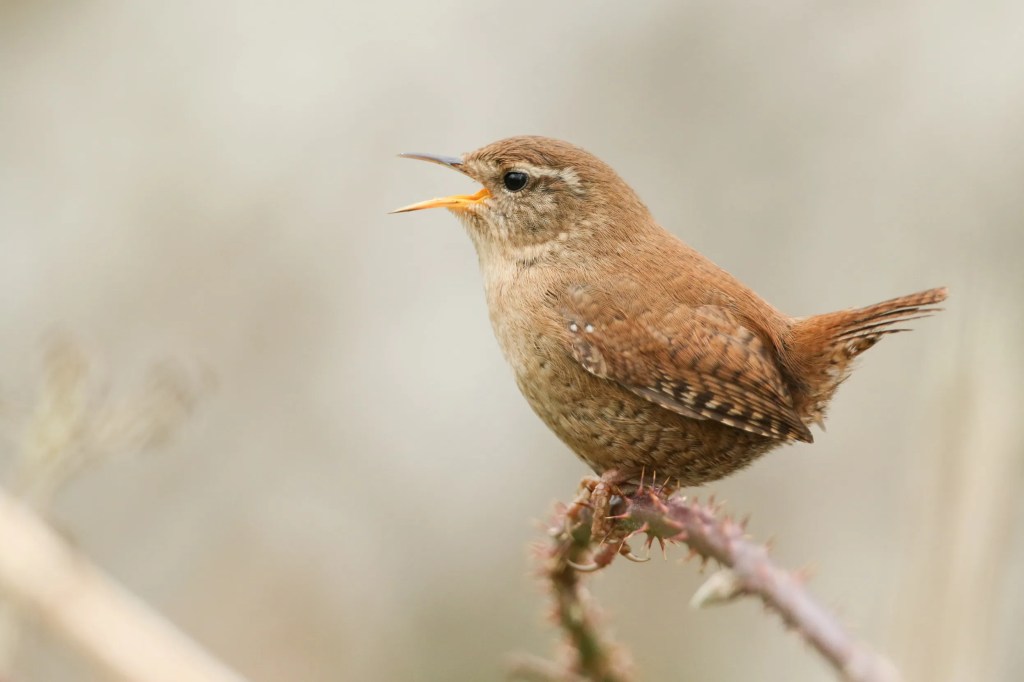
There are some four thousand songbirds in the world with a vast range of singing skills from the simple “cuckoo” of the cuckoo to the fantastic mimicry repartee of the North American mockingbird.
A walk around Bale on a Spring morning and you will hear at least twenty species singing to defend a territory and attract a mate.
Young birds learn song by listening to their own species, in a similar way that we learn to speak, they remember a few notes and then practise by repeating the notes until they have mastered the entire song.
The sounds that a bird makes come from deep in the chest where there is a syrinx placed where the trachea splits to send air to the bronchi. The syrinx is formed from cartilage and has two membranes that vibrate as air passes over them giving the bird the ability to produce two independent notes at the same time, this is achieved by tiny muscles regulating the amount of air vibrating each membrane.
This produces two very different but harmonious notes, one low frequency and one high frequency. The muscles that control this have incredibly fast contraction with some birds able to move them a hundred times in the blink of an eye, or in sub-milliseconds. The more complex the muscle structure around the syrinx the greater the ability of the bird to produce more elaborate vocal performances. The mechanics are via the syrinx but it is coordinated by the brain with nerve signals from the left and right hemispheres creating the right airflow over the syrinx.
The wren can sing thirty-six notes every second, much too fast for our ears to absorb or comprehend. Humans are only able to hear an abridged version of a bird’s song in most instances.
I was always mesmerised as a young boy when in the April woodland I would listen to the local nightingales singing at dusk. The closer I got the more notes I could hear and the more complex the song seemed, this is also true of the skylark which can remain airborne while producing an extremely varied song for several minutes which sounds quite simple from a distance but close-to gives an incredible array of notes filling the air.
Paul Laurie
(Credit: Local Lynx Magazine – Edition 166 – February – March 2026 Photography Credit – RSPB)

 Bale Village
Leave a comment